
A senior Pakistani defence official, Lt Gen (retd) Mazhar Jamil, claimed that India's long-range missile development indicates ambitions to become a global nuclear power capable of threatening Western capitals, urging international attention to India's military modernisation. He also reiterated Pakistan's commitment to deterrence stability in South Asia.

The Indian women's junior hockey team, led by Khaidem Shileima Chanu and coached by Tim White, is set to compete in the AHF Women's Junior Asia Cup in Moqi, China, from September 4 to 13. The team has undergone extensive preparations, including an exposure tour to the UK and matches against an India A side, and is confident of a strong performance against top Asian rivals.

Nepal has launched a diplomatic initiative to secure climate-related compensation from major greenhouse gas emitters, asserting that post-disaster assistance for recent deadly flash floods should be viewed as a moral and legal liability, not charity. Foreign Minister Shisir Khanal highlighted Nepal's disproportionate suffering from global warming despite negligible emissions, citing rapid glacier melt and extreme mountain disasters. The country has formally approached the Loss and Damage Fund board for urgent financial aid following a catastrophic flash flood in the Bhotekoshi river basin.

Bangladesh-China and Bangladesh-US relations have evolved from reluctant engagement to increasingly consequential strategic partnerships.

Japan is deepening its defence relationship with India while simultaneously expanding its economic, infrastructure and security engagement with countries around India -- particularly Bangladesh. The result is an emerging Japanese conception of South Asia in which India remains the strategic anchor, but the geography surrounding India is becoming increasingly important, points out Varun Arya.

'The trigger for the flood was definitely natural, but the damage that it caused was human-made.'

China sailed through the crisis in the Strait of Hormuz relatively unscathed even as the impact of its steps shielded other consuming nations from having to pay high crude oil prices.

'China wants to control and divert rivers.'

India's women's hockey team faces a challenging opening match against Olympic silver medallists China in the FIH Hockey World Cup. The crucial Pool D encounter in Amstelveen will set the tone for India's campaign, with both teams also set to meet at the upcoming Asian Games. India, buoyed by recent strong performances and an experienced squad, aims to improve on past World Cup finishes and secure a positive start against a formidable Chinese side.

'It beggars belief that Saudi Arabia would deploy military force against India, a top partner and market.'
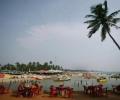
Goa is set to host the 5th Asia Cup Bridge Championship from June 21 to 27, attracting 350 players from 16 Asia-Oceania countries. India, having previously hosted in 2018, will field strong 'A' and 'B' teams across various categories, including Asian Games medallists, aiming to add to its 20 previous medals.

Gwadar is viewed as a critical pearl in China's maritime strategy as it would give a permanent logistical footprint near an important choke point - the Strait of Hormuz and the oil rich Persian Gulf, explains Commodore Venugopal Menon (retd).
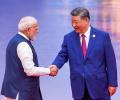
India's dual pursuit of a robust strategic partnership with Washington and a pragmatic, tension-management policy with Beijing represents the essence of modern multi-alignment. By embracing economic pragmatism, learning to compartmentalize political differences, and engaging in continuous dialogue, India can secure its borders, grow its economy, and contribute to a stable, multipolar Asian century, points out Ambassador Rajasekhar.

For India, the guiding principle should remain clear: Engage Bangladesh as a sovereign nation and society rather than through the prism of any individual leader or political party, suggests Manoj Mohanka.

The 5th Bonus Asia Cup Bridge Championships are set to begin in Goa, featuring nearly 300 players from 16 countries. Defending champions India will compete across various categories, facing strong contenders like Hong Kong and Indonesia. The event, described as the "Asian Games of bridge," highlights India's growing role in the sport.
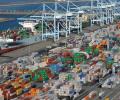
India's latest trade data reveals a significant geographical realignment, with trade surpluses growing decisively with Asian and African nations, even as surpluses with traditional partners like the US and Netherlands narrow.

If India does get $100 billion a year in FDI, it would be a game-changer in every possible way. FPIs would come rushing back, AI or no AI, points out Debashis Basu.

'After announcing that she will return to Bangladesh, if she does not, her credibility will suffer.'

Prime Minister Narendra Modi, addressing the SCO summit in Bishkek, called for a united front against terrorism and its financing, rejecting double standards. He emphasised resolving conflicts through dialogue and diplomacy, not battlefields. Modi also highlighted that connectivity projects must respect national sovereignty and territorial integrity, a veiled reference to China's Belt and Road Initiative. India's vision for SCO rests on security, connectivity, and opportunity.

New Delhi must look for formal, institutional statements issued directly from Washington rather than rely on casual pronouncements meant for local audiences, notes Ambassador Rajasekhar.

Minister of State for External Affairs B Muraleedharan said India is committed to developing friendly and mutually beneficial relations with all its neighbours under its 'Neighbourhood First' policy.
Pakistan on Wednesday welcomed 'the joint reiteration' by the United States and China to promote peace and stability in South Asia. President Barack Obama indicated on Tuesday that the US wants China to help improve relations between India and Pakistan. He reportedly raised the issue during his meeting with Chinese President Hu Jintao in Beijing.

For the foreseeable future, the most likely outcome remains continuation of the status quo. Taiwan will remain self-governing without formally declaring independence, while China continues to apply sustained pressure short of war, predict Krishnan Srinivasan and Manoj Mohanka.

The escalating crisis in West Asia and its impact on the global energy supply chain are expected to dominate deliberations at a two-day meeting of BRICS foreign ministers to be hosted by India.

India should encourage the second coming of SAARC with climate change as an urgent agenda and keeping Indian security concerns in mind as the subtext, suggest Lieutenant General Ashok Joshi (retd) and Colonel Anil Athale (retd).

US President Donald Trump will visit China from May 13 to 15 at the invitation of President Xi Jinping. The visit occurs amidst global tensions, including the war in West Asia and trade disputes between the US and China. Discussions are expected to cover China-US relations, world peace, and economic issues.

US Vice-President J D Vance's unexpected phone call to Prime Minister Narendra Modi on August 8 has ignited speculation about a potential diplomatic overture, possibly seeking India's support amidst the escalating US-Iran conflict and a shifting global power landscape, suggests Ambassador M K Bhadrakumar.

Dinesh Trivedi's success or failure in this fragile diplomatic equilibrium will have consequences extending well beyond the Indian high commission in Dhaka. It will shape India's eastern strategic environment for years to come.

The Beijing summit may have reduced immediate diplomatic uncertainty, but it did not resolve the deeper structural contest between the United States and China. That contest appears likely to define the coming decade, notes Varun Arya.

Former India hockey captain Viren Rasquinha has publicly questioned Hockey India's decision to switch the national team's jersey colour to orange, arguing that the team's identity and legacy have always been associated with blue.
For India, China's Indian Ocean power projection, maritime domain awareness, dual-use ports, underwater surveillance, antisubmarinewarfare, naval exercises with Pakistan, pose considerable pressure, depleted India's strategic depth and marginalises Indian role, points out Srikanth Kondapalli.

As New Delhi prepares to host the BWF World Championships from August 17-23, 2026, five young talents - Ayush Shetty, Unnati Hooda, Alwi Farhan, Tomoka Miyazaki, and Kalyana Nalbantova - are identified as potential breakout stars capable of challenging the sport's biggest names and redefining their careers.

Prime Minister Narendra Modi addressed the Indonesian parliament, emphasising India's commitment to development over expansionism and advocating for a free, open, and inclusive Indo-Pacific. He highlighted the strong historical ties between India and Indonesia, calling for enhanced cooperation in various sectors, including defence, technology, and counter-terrorism, amidst growing concerns over regional security.

India would confront a more entrenched China, a less dependable United States, and a regional order increasingly shaped by great-power bargaining over which it exercises limited influence, notes Amberish K Diwanji.

Indian shuttler Ashmita Chaliha defeated compatriot Rakshitha Sree Santhosh Ramraj to reach her first-ever BWF World Tour final at the Korea Masters Super 300. Chaliha, returning from a knee injury, continued her impressive run, having previously upset the top seed.

It seems odd to criticise a country for delivering growth rates in standards of living and consumption that have been perhaps the fastest, longest, and most broad-based (affecting hundreds of millions of people) in history, points out Arvind Subramanian.
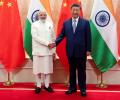
Chinese Foreign Minister Wang Yi has called on India and China to view each other as partners rather than rivals, emphasising the importance of cooperation for regional stability and development.

Chief of Defence Staff General Bipin Rawat on Saturday said that China's ambitions and aspirations to global power presented an 'omnipresent danger' to stability in South Asia.

The Nifty and Sensex outperformed Asian peers in South Korea, Japan, Taiwan and China.

India's exports increased by 15.5 per cent to USD 40.41 billion in June, but the trade deficit significantly widened to a record USD 30.43 billion due to a 31 per cent surge in imports.
